A 2,000-word answer lives in a chat tab. Tomorrow you open a fresh session, re-paste the project background, and re-ask a question you already answered. The conclusion never gets recorded — so the same debate reopens next week, and the week after.
Case study
A big AI answer should become reusable project memory.
Based on a real product session: a builder asked why their location-sharing map didn't feel as alive as Find My or Life360. Two AIs gave long, genuinely useful answers — and without Fob, both would have scrolled out of a chat tab by morning. Here's what Fob did with them instead.
The context tax
The problem isn't the answer. It's what happens after.
The answer becomes a saved decision, a guardrail, and a context packet you can hand to any AI. The next session starts from the conclusion instead of from scratch — and the decision is there the next time someone questions it.
The session
Two perspectives on one question.
The builder asked both workers.
"The map doesn't feel like Find My or Life360. What can you find? No changes, just responses."
No code changes requested — just a diagnosis of the feel, from two different angles at once.
The product & UI read.
Claude treated it as a feel problem: too many pins competing for attention, not enough visual restraint, and places that should cluster instead of stack. Its core point — the map looked busy, which reads as "data" rather than "presence." A calm map says "everyone's fine" faster than a dense one.
The technical read.
Codex treated it as a systems problem: location update cadence, motion prediction between pings, the battery-versus-freshness tradeoff, and sync lag. Its core point — a map can render at a smooth 60fps and still feel stale if the underlying dots only move every 30–60 seconds.
One decision candidate.
Verdict: the app was — correctly — built as a battery-friendly family status map, not a literal live tracker. The two reads weren't in conflict; they described the same tradeoff.
Recommendation: don't rebuild the calm map. Add a distinct "live mode" that ramps update frequency only while someone is actively being watched. Immediacy on demand, battery story intact.
What this looked like in Fob
The conclusion becomes a saved decision — and comes back on command.

The important part
Fob made the answer actionable.
Save the decisionRecord "live mode is a distinct mode" so future prompts don't reopen the same debate.
Pressure-test itSend the fix back to Claude and Codex to weigh UI restraint against sync and battery risk.
Hand it offGenerate a copy-ready packet for ChatGPT, Gemini, Cursor, or tomorrow's session.
And it persists
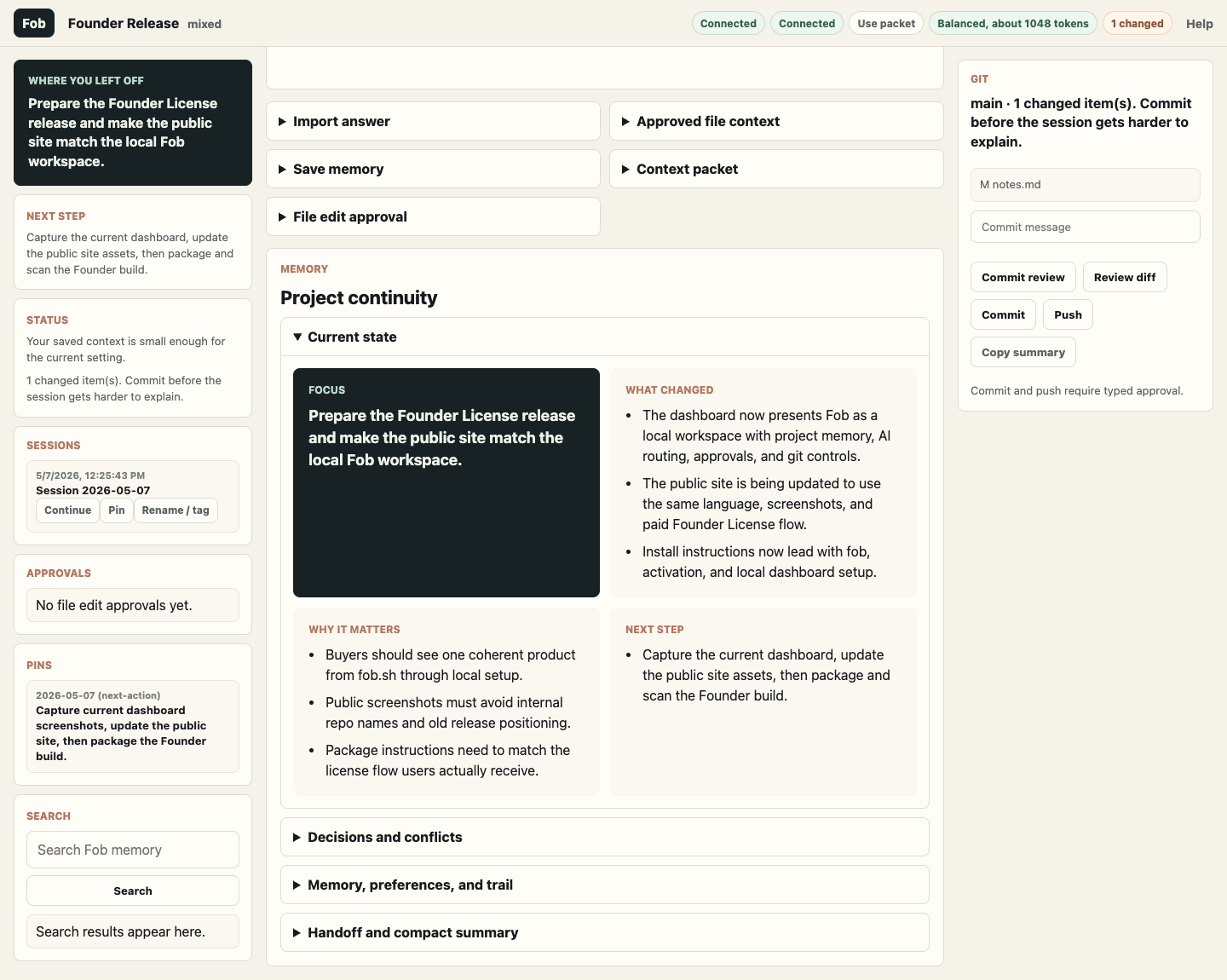
The decision lives in the local dashboard, not a chat tab.
The outcome
Next session, the debate didn't reopen.
The "live mode is a separate mode" decision is now project memory. The next time anyone asks "should we make the map more live?", Fob surfaces the saved verdict and its guardrail before the conversation restarts — so the team builds the feature instead of re-litigating it. That's the whole product in one line: continuity, not chatter.
Try it on your project